Depicting Fragment Combinations
Problem
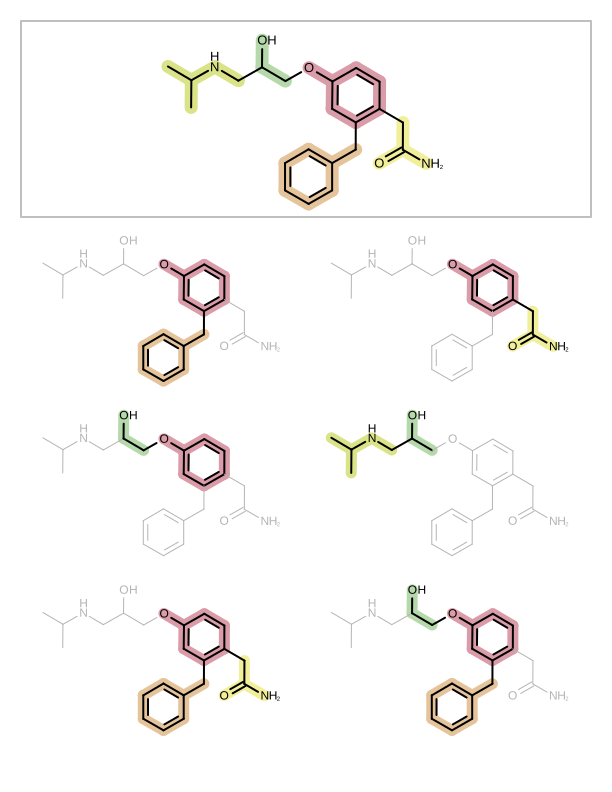
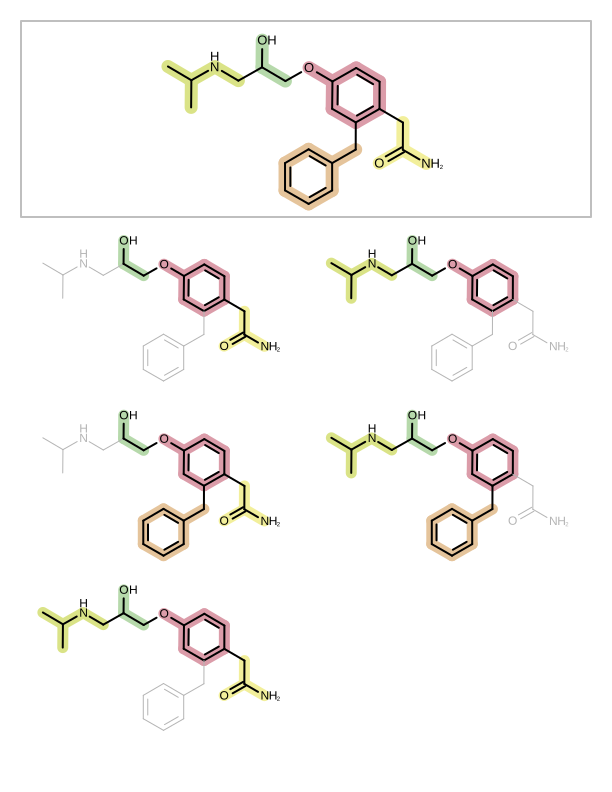
You want to depict fragment combinations generated by the algorithm described in Enumerating Fragment Combinations. See example in Table 1.
page 1 |
page 2 |
|
|
Ingredients
|
Difficulty Level
🌶️ 🌶️
Download
Source Code
enumfrags2pdf
#!/usr/bin/env python3
# (C) 2026 Cadence Design Systems, Inc. (Cadence)
# All rights reserved.
# TERMS FOR USE OF SAMPLE CODE The software below ("Sample Code") is
# provided to current licensees or subscribers of Cadence products or
# SaaS offerings (each a "Customer").
# Customer is hereby permitted to use, copy, and modify the Sample Code,
# subject to these terms. Cadence claims no rights to Customer's
# modifications. Modification of Sample Code is at Customer's sole and
# exclusive risk. Sample Code may require Customer to have a then
# current license or subscription to the applicable Cadence offering.
# THE SAMPLE CODE IS PROVIDED "AS IS", WITHOUT WARRANTY OF ANY KIND,
# EXPRESS OR IMPLIED.  OPENEYE DISCLAIMS ALL WARRANTIES, INCLUDING, BUT
# NOT LIMITED TO, WARRANTIES OF MERCHANTABILITY, FITNESS FOR A
# PARTICULAR PURPOSE AND NONINFRINGEMENT. In no event shall Cadence be
# liable for any damages or liability in connection with the Sample Code
# or its use.

"""Depict connected fragment combinations in a multi-page report."""

import argparse
import enum
import os
import pathlib
import sys
from collections.abc import Callable, Iterator
from itertools import combinations

from openeye import oechem, oedepict, oegrapheme, oemedchem
from rich_argparse import HelpPreviewAction, RichHelpFormatter

__SCRIPT_NAME__ = pathlib.Path(__file__).absolute().stem
__SCRIPT_DESC__ = "Depict connected fragment combinations in a multi-page report."
__SCRIPT_TOOLKITS__ = ["oechem", "oedepict", "oegrapheme", "oemedchem"]
__SCRIPT_CATEGORIES__ = ["depiction"]


def parse_args() -> argparse.Namespace:
    """Parse command-line arguments."""
    parser = argparse.ArgumentParser(
        add_help=True,
        formatter_class=RichHelpFormatter,
        description="[yellow]" + __SCRIPT_DESC__ + "[/yellow]",
    )

    input_group = parser.add_argument_group("Input options")
    input_group.add_argument(
        "--mol",
        type=str,
        required=True,
        metavar="MOL-FILE",
        help="input molecule file",
    )

    report_group = parser.add_argument_group("Report options")
    report_group.add_argument(
        "--report",
        type=str,
        required=True,
        metavar="REPORT-FILE",
        help="output report file (PDF)",
    )
    report_group.add_argument(
        "--rows",
        type=int,
        default=3,
        choices=range(2, 6),
        metavar="N",
        help="number of rows per page (default: %(default)s)",
    )
    report_group.add_argument(
        "--cols",
        type=int,
        default=2,
        choices=range(1, 3),
        metavar="N",
        help="number of columns per page (default: %(default)s)",
    )
    report_group.add_argument(
        "--page-by-page",
        action="store_true",
        help="write pages of report to separate numbered image files",
    )

    frag_group = parser.add_argument_group("Fragmentation options")
    frag_group.add_argument(
        "--frag-type",
        type=FragmentationType,
        default=FragmentationType.FunctionalGroup,
        choices=list(FragmentationType),
        help="fragmentation type (default: %(default)s)",
    )

    parser.add_argument("--help-image", action=HelpPreviewAction)
    return parser.parse_args()


def main() -> int:
    """Depict connected fragment combinations in a multi-page report."""
    args = parse_args()
    _check_report_file(args)

    # open input file
    input_stream = oechem.oemolistream()
    if not input_stream.open(args.mol):
        oechem.OEThrow.Fatal("Cannot open input file!")

    # read a molecule
    mol = oechem.OEGraphMol()
    if not oechem.OEReadMolecule(input_stream, mol):
        oechem.OEThrow.Fatal("Cannot read input file!")
    oedepict.OEPrepareDepiction(mol)

    # initialize fragmentation function
    frag_func = _get_fragmentation_function(args.frag_type)

    # initialize multi-page report
    report_options = oedepict.OEReportOptions(args.rows, args.cols)
    report_options.SetFooterHeight(25.0)
    report_options.SetHeaderHeight(report_options.GetPageHeight() / 4.0)
    report = oedepict.OEReport(report_options)

    # setup depiction options
    display_options = oedepict.OE2DMolDisplayOptions()
    cell_width, cell_height = report.GetCellWidth(), report.GetCellHeight()
    display_options.SetDimensions(cell_width, cell_height, oedepict.OEScale_AutoScale)
    display_options.SetTitleLocation(oedepict.OETitleLocation_Hidden)
    display_options.SetAtomColorStyle(oedepict.OEAtomColorStyle_WhiteMonochrome)
    display_options.SetAtomLabelFontScale(1.2)

    # depict molecule with fragment combinations
    depict_molecule_with_fragment_combinations(report, mol, frag_func, display_options)

    if args.page_by_page:
        oedepict.OEWriteReportPageByPage(args.report, report)
    else:
        oedepict.OEWriteReport(args.report, report)

    return os.EX_OK


def depict_molecule_with_fragment_combinations(
    report: oedepict.OEReport,
    mol: oechem.OEMolBase,
    frag_func: Callable,
    opts: oedepict.OE2DMolDisplayOptions,
) -> None:
    """
    Depict molecule with all adjacent fragment combinations.

    Fragments the molecule, generates all connected fragment pair combinations,
    and renders each combination into a report cell with highlighted fragments
    and faded non-fragment regions. The original fragmentation is shown in
    each page header.
    """
    # fragment molecule
    frags = list(frag_func(mol))

    # assign fragment indexes
    str_tag = "fragment idx"
    int_tag = oechem.OEGetTag(str_tag)
    for frag_idx, frag in enumerate(frags):
        for bond in frag.GetBonds():
            bond.SetData(int_tag, frag_idx)

    # setup depiction styles
    num_frags = len(frags)
    colors = list(oechem.OEGetLightColors())
    if len(colors) < num_frags:
        colors = list(
            oechem.OEGetColors(oechem.OEYellowTint, oechem.OEDarkOrange, num_frags)
        )

    bond_glyph = ColorBondByFragmentIndex(colors, int_tag)

    line_width_scale = 0.75
    fade_highlight = oedepict.OEHighlightByColor(oechem.OEGrey, line_width_scale)

    # generate adjacent fragment combinations
    frag_combs = get_fragment_atom_bond_set_combinations(frags)

    # depict each fragment combination
    for frag in frag_combs:
        cell = report.NewCell()
        disp = oedepict.OE2DMolDisplay(mol, opts)

        frag_atoms = oechem.OEIsAtomMember(frag.GetAtoms())
        frag_bonds = oechem.OEIsBondMember(frag.GetBonds())

        not_frag_atoms = oechem.OENotAtom(frag_atoms)
        not_frag_bonds = oechem.OENotBond(frag_bonds)

        oedepict.OEAddHighlighting(disp, fade_highlight, not_frag_atoms, not_frag_bonds)
        oegrapheme.OEAddGlyph(disp, bond_glyph, frag_bonds)

        oedepict.OERenderMolecule(cell, disp)

    # depict original fragmentation in each header
    cell_width, cell_height = report.GetHeaderWidth(), report.GetHeaderHeight()
    opts.SetDimensions(cell_width, cell_height, oedepict.OEScale_AutoScale)
    opts.SetAtomColorStyle(oedepict.OEAtomColorStyle_WhiteMonochrome)
    disp = oedepict.OE2DMolDisplay(mol, opts)
    oegrapheme.OEAddGlyph(disp, bond_glyph, oechem.IsTrueBond())

    header_pen = oedepict.OEPen(
        oechem.OEWhite, oechem.OELightGrey, oedepict.OEFill_Off, 2.0
    )
    for header in report.GetHeaders():
        oedepict.OERenderMolecule(header, disp)
        oedepict.OEDrawBorder(header, header_pen)


class ColorBondByFragmentIndex(oegrapheme.OEBondGlyphBase):
    """Bond glyph that colors bonds by their fragment index."""

    def __init__(self, color_list: list, tag: int) -> None:
        """Initialize with color list and fragment tag."""
        oegrapheme.OEBondGlyphBase.__init__(self)
        self.color_list = color_list
        self.tag = tag

    def RenderGlyph(  # noqa: N802
        self, disp: oedepict.OE2DMolDisplay, bond: oechem.OEBondBase
    ) -> bool:
        """Render a colored line glyph on a bond."""
        bond_disp = disp.GetBondDisplay(bond)
        if bond_disp is None or not bond_disp.IsVisible():
            return False

        if not bond.HasData(self.tag):
            return False

        linewidth = disp.GetScale() / 2.0
        color = self.color_list[bond.GetData(self.tag)]
        pen = oedepict.OEPen(color, color, oedepict.OEFill_Off, linewidth)

        atom_disp_bgn = disp.GetAtomDisplay(bond.GetBgn())
        atom_disp_end = disp.GetAtomDisplay(bond.GetEnd())

        layer = disp.GetLayer(oedepict.OELayerPosition_Below)
        layer.DrawLine(atom_disp_bgn.GetCoords(), atom_disp_end.GetCoords(), pen)

        return True

    def CreateCopy(self):  # noqa: ANN201, N802
        """Create a copy of this glyph."""
        return ColorBondByFragmentIndex(self.color_list, self.tag).__disown__()


def _is_adjacent_atom_bond_sets(
    frag_a: oechem.OEAtomBondSet,
    frag_b: oechem.OEAtomBondSet,
) -> bool:
    """Check if two atom/bond sets share an adjacent atom pair."""
    for atom_a in frag_a.GetAtoms():
        for atom_b in frag_b.GetAtoms():
            if atom_a.GetBond(atom_b) is not None:
                return True
    return False


def _is_adjacent_atom_bond_set_combination(
    frag_list: tuple[oechem.OEAtomBondSet, ...],
) -> bool:
    """Check if a combination of fragments forms a single connected component."""
    parts = [0] * len(frag_list)
    num_parts = 0

    for idx, frag in enumerate(frag_list):
        if parts[idx] != 0:
            continue

        num_parts += 1
        parts[idx] = num_parts
        _traverse_fragments(frag, frag_list, parts, num_parts)

    return num_parts == 1


def _traverse_fragments(
    act_frag: oechem.OEAtomBondSet,
    frag_list: tuple[oechem.OEAtomBondSet, ...],
    parts: list[int],
    num_parts: int,
) -> None:
    """Recursively traverse adjacent fragments to find connected components."""
    for idx, frag in enumerate(frag_list):
        if parts[idx] != 0:
            continue

        if not _is_adjacent_atom_bond_sets(act_frag, frag):
            continue

        parts[idx] = num_parts
        _traverse_fragments(frag, frag_list, parts, num_parts)


def _combine_and_connect_atom_bond_sets(
    frag_list: tuple[oechem.OEAtomBondSet, ...],
) -> oechem.OEAtomBondSet:
    """Combine fragment atom/bond sets and add connecting bonds."""
    combined = oechem.OEAtomBondSet()
    for frag in frag_list:
        for atom in frag.GetAtoms():
            combined.AddAtom(atom)
        for bond in frag.GetBonds():
            combined.AddBond(bond)

    # add connecting bonds
    for atom_a in combined.GetAtoms():
        for atom_b in combined.GetAtoms():
            if atom_a.GetIdx() < atom_b.GetIdx():
                continue

            bond = atom_a.GetBond(atom_b)
            if bond is None:
                continue
            if combined.HasBond(bond):
                continue

            combined.AddBond(bond)

    return combined


def get_fragment_atom_bond_set_combinations(
    frag_list: list[oechem.OEAtomBondSet],
) -> list[oechem.OEAtomBondSet]:
    """Generate all adjacent connected fragment combinations."""
    frag_combs: list[oechem.OEAtomBondSet] = []

    num_frags = len(frag_list)
    for n in range(2, num_frags):
        for frag_comb in combinations(frag_list, n):
            if _is_adjacent_atom_bond_set_combination(frag_comb):
                frag = _combine_and_connect_atom_bond_sets(frag_comb)
                frag_combs.append(frag)

    return frag_combs


class FragmentationType(enum.Enum):
    """Molecule fragmentation type."""

    FunctionalGroup = "func-group"
    RingChain = "ring-chain"
    RingLinkerSideChain = "ring-linker-sidechain"

    def __str__(self) -> str:
        """Convert to string representation."""
        return self.value


def _get_fragmentation_function(
    frag_type: FragmentationType,
) -> Callable[[oechem.OEMolBase], Iterator[oechem.OEAtomBondSet]]:
    """Return the fragmentation function for the given type."""
    match frag_type:
        case FragmentationType.RingChain:
            return oemedchem.OEGetRingChainFragments
        case FragmentationType.RingLinkerSideChain:
            return oemedchem.OEGetRingLinkerSideChainFragments
    return oemedchem.OEGetFuncGroupFragments


def _check_report_file(args: argparse.Namespace) -> None:
    """Validate report file format and adjust page-by-page if needed."""
    ext = pathlib.Path(args.report).suffix[1:]
    if not args.page_by_page and not oedepict.OEIsRegisteredMultiPageImageFile(ext):
        oechem.OEThrow.Warning("Report will be generated into separate pages!")
        args.page_by_page = True


setattr(main, "__SCRIPT_NAME__", __SCRIPT_NAME__)
setattr(main, "__SCRIPT_DESC__", __SCRIPT_DESC__)
setattr(main, "__SCRIPT_TOOLKITS__", __SCRIPT_TOOLKITS__)
setattr(main, "__SCRIPT_CATEGORIES__", __SCRIPT_CATEGORIES__)

if __name__ == "__main__":
    sys.exit(main())
Solution
The depict_molecule_with_fragment_combinations function shows how to visualize fragment combinations returned by the get_fragment_atom_bond_set_combinations function. First, a molecule is fragmented using one of the fragmentation functions described in the Enumerating Fragment Combinations section. Before enumerating the fragment combinations, an index is assigned to each bond of the molecule that indicates which fragment the bond belongs to. Then a color list is created that is used by the ColorBondByFragmentIndex class to annotate the bonds based on their fragment index. A highlighting style is also set up in order to fade the part of the molecule that does not belong to a given fragment combination. Then the get_fragment_atom_bond_set_combinations function is called to generate all adjacent fragment combinations and return them as a list of OEAtomBondSet objects. Each fragment combination is then depicted in a separate cell of the report by using highlighting and bond annotation . Finally, in each page header, the original molecule fragmentation is depicted.
def depict_molecule_with_fragment_combinations(
    report: oedepict.OEReport,
    mol: oechem.OEMolBase,
    frag_func: Callable,
    opts: oedepict.OE2DMolDisplayOptions,
) -> None:
    """
    Depict molecule with all adjacent fragment combinations.

    Fragments the molecule, generates all connected fragment pair combinations,
    and renders each combination into a report cell with highlighted fragments
    and faded non-fragment regions. The original fragmentation is shown in
    each page header.
    """
    # fragment molecule
    frags = list(frag_func(mol))

    # assign fragment indexes
    str_tag = "fragment idx"
    int_tag = oechem.OEGetTag(str_tag)
    for frag_idx, frag in enumerate(frags):
        for bond in frag.GetBonds():
            bond.SetData(int_tag, frag_idx)

    # setup depiction styles
    num_frags = len(frags)
    colors = list(oechem.OEGetLightColors())
    if len(colors) < num_frags:
        colors = list(
            oechem.OEGetColors(oechem.OEYellowTint, oechem.OEDarkOrange, num_frags)
        )

    bond_glyph = ColorBondByFragmentIndex(colors, int_tag)

    line_width_scale = 0.75
    fade_highlight = oedepict.OEHighlightByColor(oechem.OEGrey, line_width_scale)

    # generate adjacent fragment combinations
    frag_combs = get_fragment_atom_bond_set_combinations(frags)

    # depict each fragment combination
    for frag in frag_combs:
        cell = report.NewCell()
        disp = oedepict.OE2DMolDisplay(mol, opts)

        frag_atoms = oechem.OEIsAtomMember(frag.GetAtoms())
        frag_bonds = oechem.OEIsBondMember(frag.GetBonds())

        not_frag_atoms = oechem.OENotAtom(frag_atoms)
        not_frag_bonds = oechem.OENotBond(frag_bonds)

        oedepict.OEAddHighlighting(disp, fade_highlight, not_frag_atoms, not_frag_bonds)
        oegrapheme.OEAddGlyph(disp, bond_glyph, frag_bonds)

        oedepict.OERenderMolecule(cell, disp)

    # depict original fragmentation in each header
    cell_width, cell_height = report.GetHeaderWidth(), report.GetHeaderHeight()
    opts.SetDimensions(cell_width, cell_height, oedepict.OEScale_AutoScale)
    opts.SetAtomColorStyle(oedepict.OEAtomColorStyle_WhiteMonochrome)
    disp = oedepict.OE2DMolDisplay(mol, opts)
    oegrapheme.OEAddGlyph(disp, bond_glyph, oechem.IsTrueBond())

    header_pen = oedepict.OEPen(
        oechem.OEWhite, oechem.OELightGrey, oedepict.OEFill_Off, 2.0
    )
    for header in report.GetHeaders():
        oedepict.OERenderMolecule(header, disp)
        oedepict.OEDrawBorder(header, header_pen)
The ColorBondByFragmentIndex bond annotation class draws a “stick” underneath each bond. The color of the “stick” is determined by the index attached to the bond as generic data.
class ColorBondByFragmentIndex(oegrapheme.OEBondGlyphBase):
    """Bond glyph that colors bonds by their fragment index."""

    def __init__(self, color_list: list, tag: int) -> None:
        """Initialize with color list and fragment tag."""
        oegrapheme.OEBondGlyphBase.__init__(self)
        self.color_list = color_list
        self.tag = tag

    def RenderGlyph(  # noqa: N802
        self, disp: oedepict.OE2DMolDisplay, bond: oechem.OEBondBase
    ) -> bool:
        """Render a colored line glyph on a bond."""
        bond_disp = disp.GetBondDisplay(bond)
        if bond_disp is None or not bond_disp.IsVisible():
            return False

        if not bond.HasData(self.tag):
            return False

        linewidth = disp.GetScale() / 2.0
        color = self.color_list[bond.GetData(self.tag)]
        pen = oedepict.OEPen(color, color, oedepict.OEFill_Off, linewidth)

        atom_disp_bgn = disp.GetAtomDisplay(bond.GetBgn())
        atom_disp_end = disp.GetAtomDisplay(bond.GetEnd())

        layer = disp.GetLayer(oedepict.OELayerPosition_Below)
        layer.DrawLine(atom_disp_bgn.GetCoords(), atom_disp_end.GetCoords(), pen)

        return True

    def CreateCopy(self):  # noqa: ANN201, N802
        """Create a copy of this glyph."""
        return ColorBondByFragmentIndex(self.color_list, self.tag).__disown__()
Usage
See Download section to download the script.
> enumfrags2pdf --help
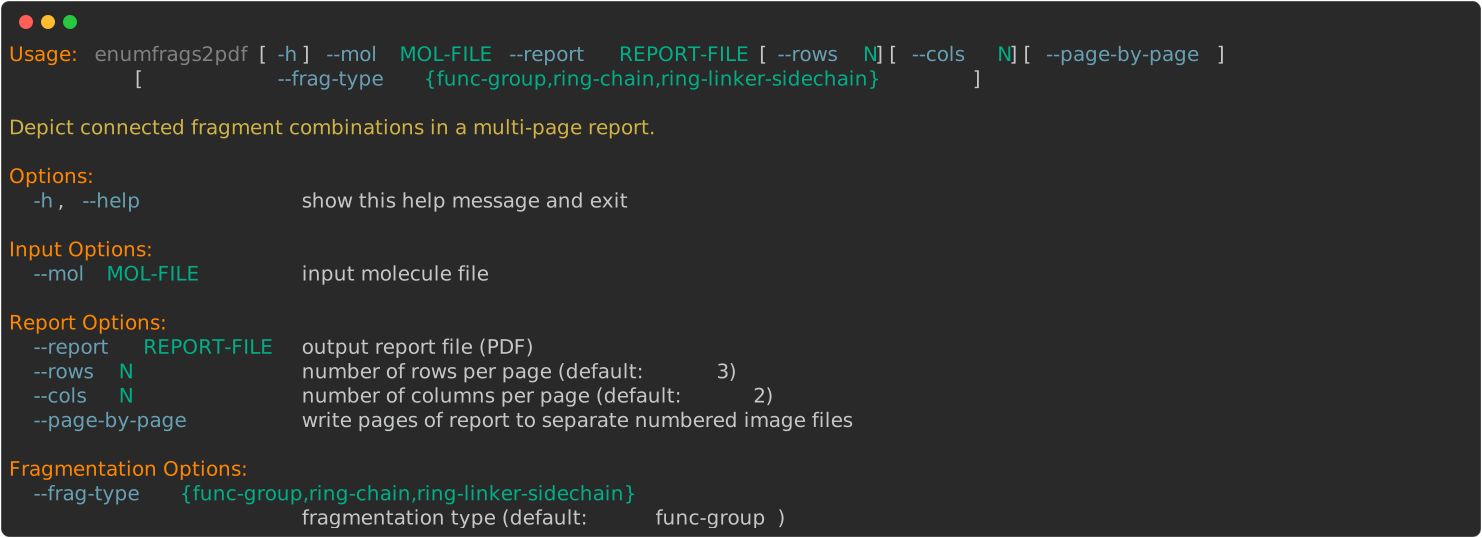
The following will generate the multi-page PDF shown in
Table 1.
> enumfrags2pdf --mol molecule.ism --report report.pdf
See also in OEChem TK manual
Theory
Predicates Functors chapter
Generic Data chapter
API
OEAtomBondSet class
OEColorStop class
OEIsAtomMember predicate
OEIsBondMember predicate
OENotAtom predicate
OENotBond predicate
OELinearColorGradient class
See also in OEMedChem TK manual
Theory
Molecule Fragmentation chapter
API
OEGetFuncGroupFragments function
OEGetRingChainFragments function
OEGetRingLinkerSideChainFragments function
See also in OEDepict TK manual
Theory
Molecule Depiction chapter
Highlighting chapter
API
OE2DMolDisplay class
OEAddHighlighting function
OEHighlightByColor class
OERenderMolecule function
OEReport class
See also in GraphemeTM TK manual
Theory
Annotating Atoms and Bonds chapter
API
OEAddGlyph function
OEBondGlyphBase abstract base class