Antibody Humanization Tutorial
The Humanize Fv Antibodies Floe humanizes antibody sequences. It primarily utilizes antibody LLMs to introduce mutations that increase the humanness score of the provided sequences. Additionally, this floe can do grafting prior to humanization which takes the complementarity-determining regions (CDRs) and places them onto the closest human germline.
Inputs
Inputs can be provided as a dataset containg heavy and light chain sequences, or as a dataset containing an antibody design unit on each record. In the case where both are present, the floe will use the structures and ignore the sequence inputs.
When using sequences, the “VH Sequence Field” and “VL Sequence Field” must be specified to indicate the fields containing the heavy and light sequences. IMGT is used as the default numbering scheme for all analysis, but this can be modified by the user if need be. Other available numbering schemes include Chothia, Martin, and Kabat.
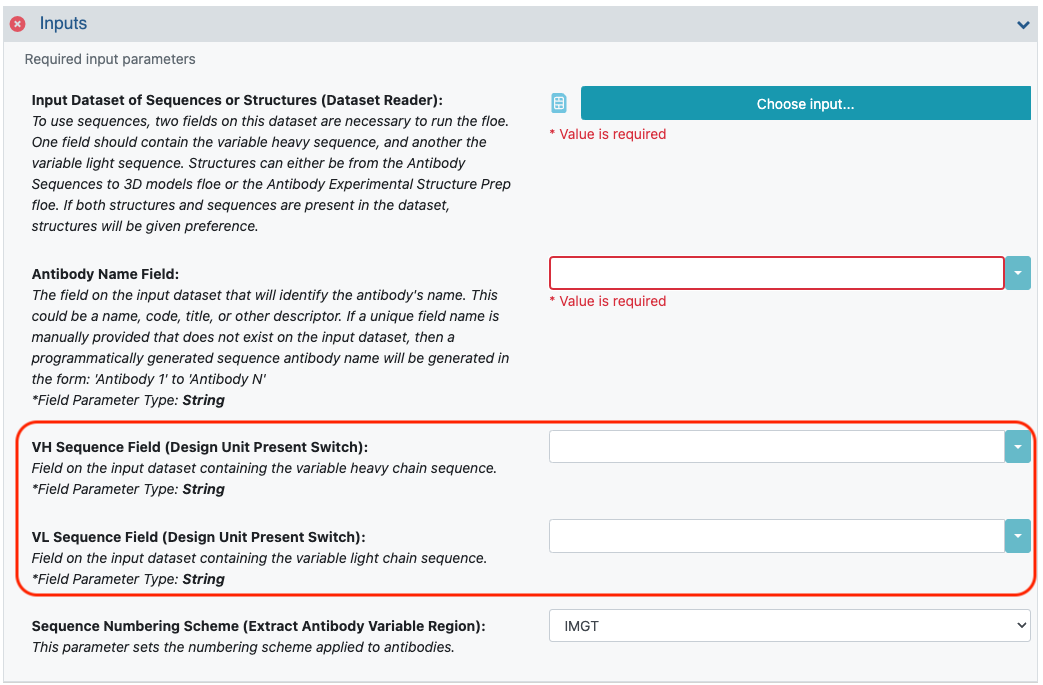
Figure 1. Inputs for the humanizaiton floe. The red box indicates the fields required when sequences are used as inputs.
Humanization Options
The user has the option to use Sapiens [Prihoda-2022] or Ablang2 [Olsen-2024] as the antibody LLM that will be used for humanization. The number of rounds of optimization can be specified by the user. In each subsequent iteration, the humanized sequence from the previous iteration is used as input. Increasing the number of iterations increases the number of mutations in the final sequence. The floe uses three iterations as default as that has been found to produce the best results with Sapiens [Prihoda-2022].
In the case where mutations need to be limited to the antibody surface, an “Only Mutate Surface” toggle is provided. This feature either builds a structure given the sequences or, if a structure is provided, uses the provided structure to limit mutations to just the residues that might be found on the antibody surface.
Finally, the floe uses a 20% human OASis identity cutoff [Prihoda-2022] to determine whether a peptide in the sequence is human. This value can be modified by the user. A higher cutoff translates to a more stringent humanness evaluation and will produce lower humanness scores.
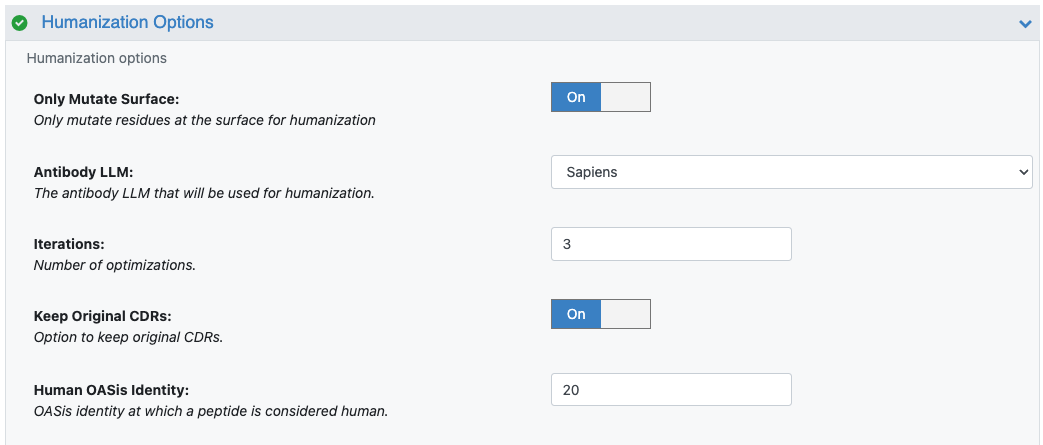
Figure 2. Humanization options.
Germline Grafting Options
Sequences can be grafted onto the closest germline before humanization by using the “Graft CDRs onto Closest Germline” toggle. In the case where no further humanization is intended, the user can set the “Iterations” field to 0. During germline grafting, the user can choose to preserve the residues belonging to the vernier regions. To determine the locations of the CDR regions and the vernier regions, the floe uses the numbering scheme specified in the inputs.
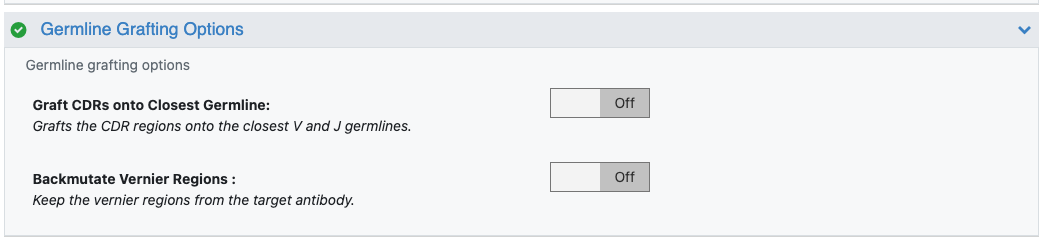
Figure 3. Germline grafting options.
Humanization Results
Along with a dataset containg the humanized sequences, the floe will output a floe report containing a table that showcases the starting and ending humanness scores for each antibody. It will also contain a sequence comparison for each antibody that highlights the mutated residues and their locations.
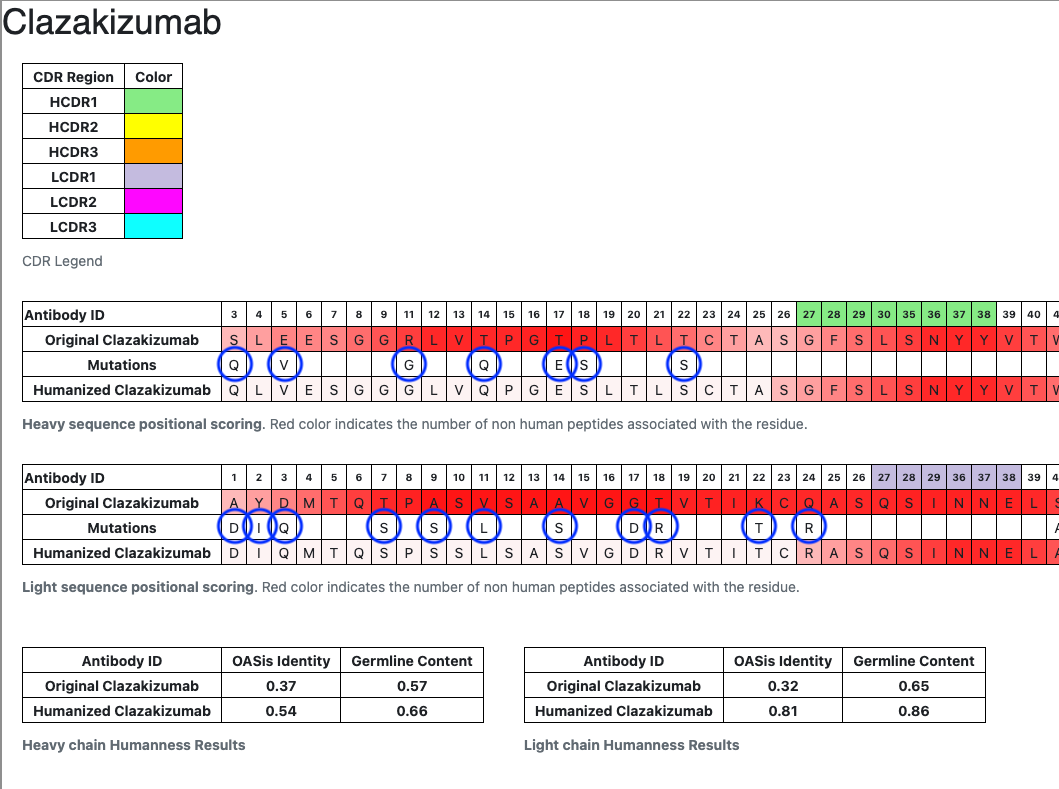
Figure 4. Parital humanziation floe report for Clazakizumab parental sequence. The report provides a comparison of the original and humanized sequences for both the heavy and light chains. Location of mutations have been marked with a blue circle in this figure.