FE-NES theory
The Free Energy-Nonequilibrium Switching (FE-NES) method calculates relative binding affinities (RBFE) of several ligands to a given target. The theory was developed during the 1990s ( [Jarzynski-1997a]; [Jarzynski-1997b]). However, due to its high computational demand, the approach was not fully explored. However, pioneering work by Hummer and Gapsys ([Gapsys-2020]; [Hummer-2001]; [Hummer-2002]) has tapped the potential of this method.
In general, the relative binding affinity \(\Delta\Delta G\) is defined as the free energy difference between the binding affinities of ligand A \(\Delta G_{A}\) and ligand B \(\Delta G_{B}\) related to their target: \(\Delta\Delta G=\Delta G_{B}-\Delta G_{A}\). Nevertheless, the direct computation of these affinities could be quite challenging because a direct binding process has to be simulated in silico, and often, other thermodynamic paths are used. During the last 30 years, alchemical methods have been proven to be very effective in calculating the RBFE between two ligands; in this context, the ligand pair involved in the RBFE calculations is called an edge. In this approach, a starting ligand A is “mutated” into a final one B in different environments. For example, \(\Delta\Delta G\) can also be computed following the alternative thermodynamic paths shown in Figure 1, where \(\Delta G_{Bound}\) and \(\Delta G_{Unbound}\) are estimated by using alchemical methods: \(\Delta\Delta G=\Delta G_{Bound}-\Delta G_{Unbound}\).
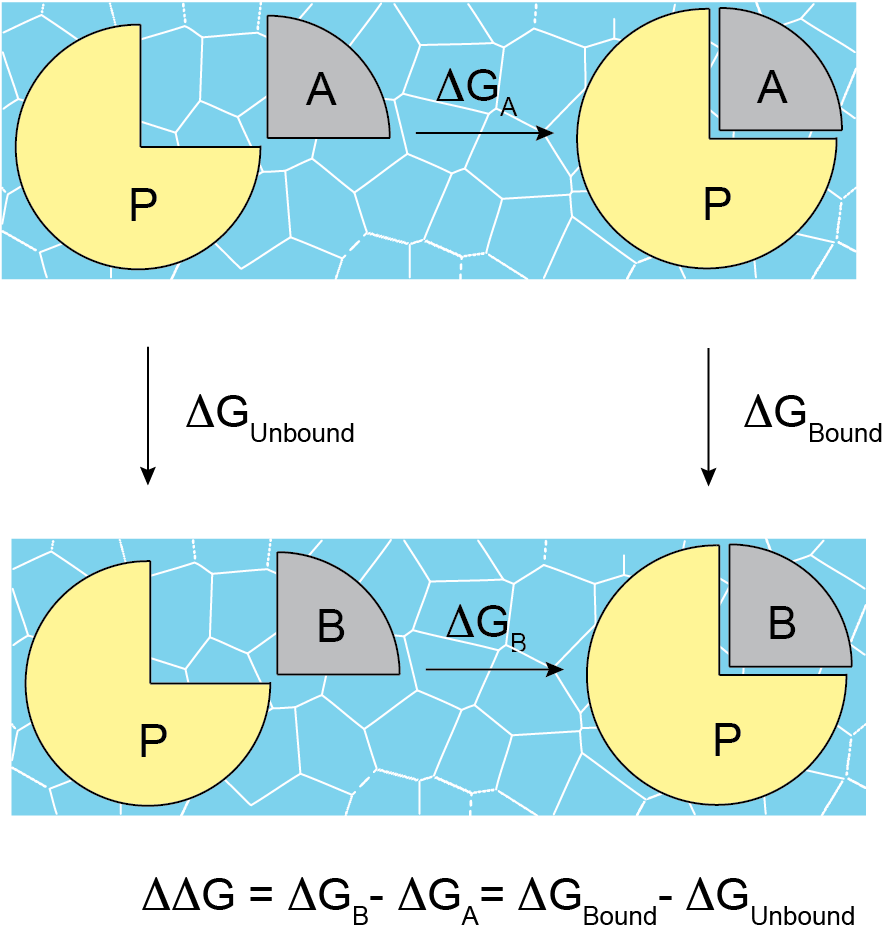
Figure 1. RBFE and alternative thermodynamic paths.
In the unbound path, the starting ligand is mutated into the final one only in solution, while in the bound path, the mutation happens in the complex binding site. In the NES approach, these mutations are done in a nonequilibrium regime many times, starting from equilibrium snapshots and building the forward and reverse work probability distribution functions that can be used to estimate \(\Delta G_{Bound}\) and \(\Delta G_{Unbound}\). For this reason, before running, the NES methodology requires having the equilibrium ensembles for the bound and the unbound systems.
In addition, the implemented NES floe protocol tries to estimate the binding affinities from the computed RBFEs by using the maximum likelihood estimator method [Xu-2019] and making it possible to compare the predicted affinity values with experimental results derived, such as activity measurements, IC50, and so on.
Caution
RBFE calculations via alchemical methods must be carefully used. In particular, mutations should be carried out between similar ligands; that is, where a common ligand scaffold can be identified and small different functional groups are mutated.