OMEGA Overview
OMEGA is a fast, systematic conformer generator that produces high-quality 3D conformations of drug-like molecules. Conformation generation is a foundational step in many molecular modeling workflows because the biologically relevant properties of a molecule and the interactions with its environment depend on the accessible three-dimensional shapes it can adopt. OMEGA generates conformer ensembles rapidly while maintaining accuracy, affordability, robustness across diverse chemical space, and utility for downstream applications.
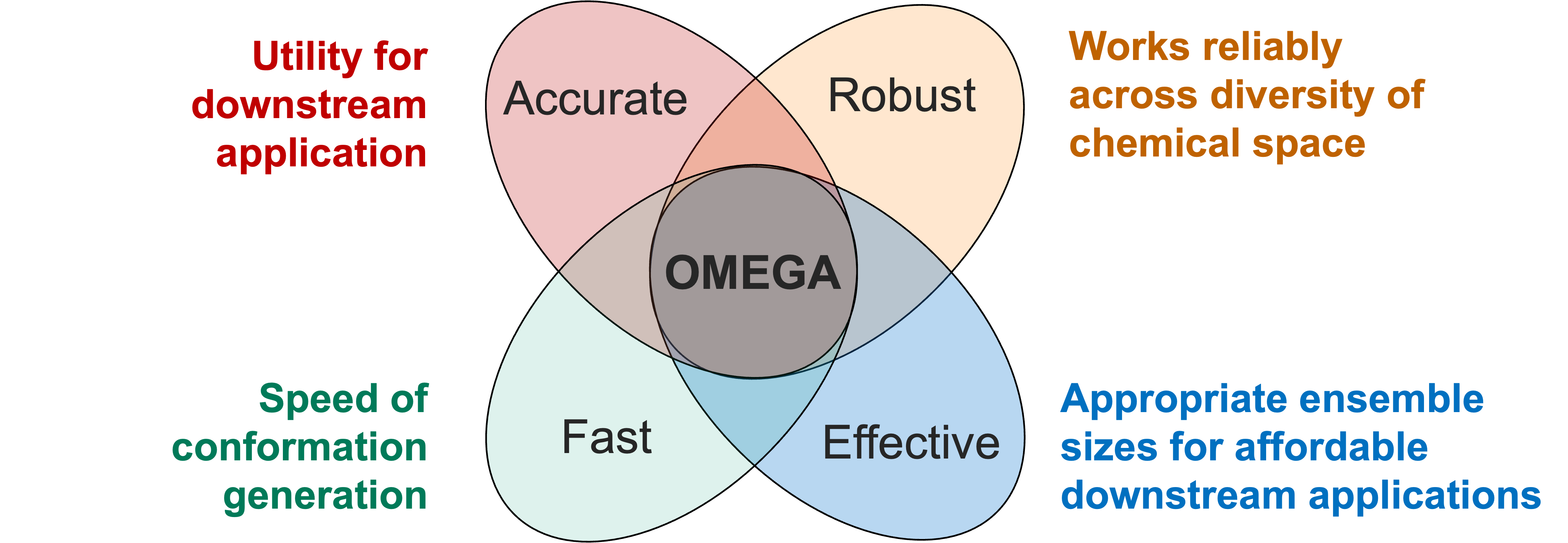
Figure 1. Key objectives of the OMEGA conformer generator: speed, accuracy, and broad coverage of chemical space.
Two Approaches to Conformer Generation
OMEGA uses two main approaches to generate 3D conformers based on the topology of the input molecule.
Torsion Driving (TD): Used for linear molecules with only small rings. This method samples the torsional degrees of freedom along rotatable bonds, making it fast and effective at covering the conformational space of typical drug-like molecules.
Distance Geometry (DG): Used for macrocycles, which are molecules with large rings. In this approach, atoms and rigid fragments are placed randomly in Cartesian space, then an error function is minimized to satisfy distance constraints derived from MMFF94 force field parameters, followed by force field refinement. This approach is general and provides thorough conformational coverage, making it especially suited for macrocycles where torsion driving cannot be applied.
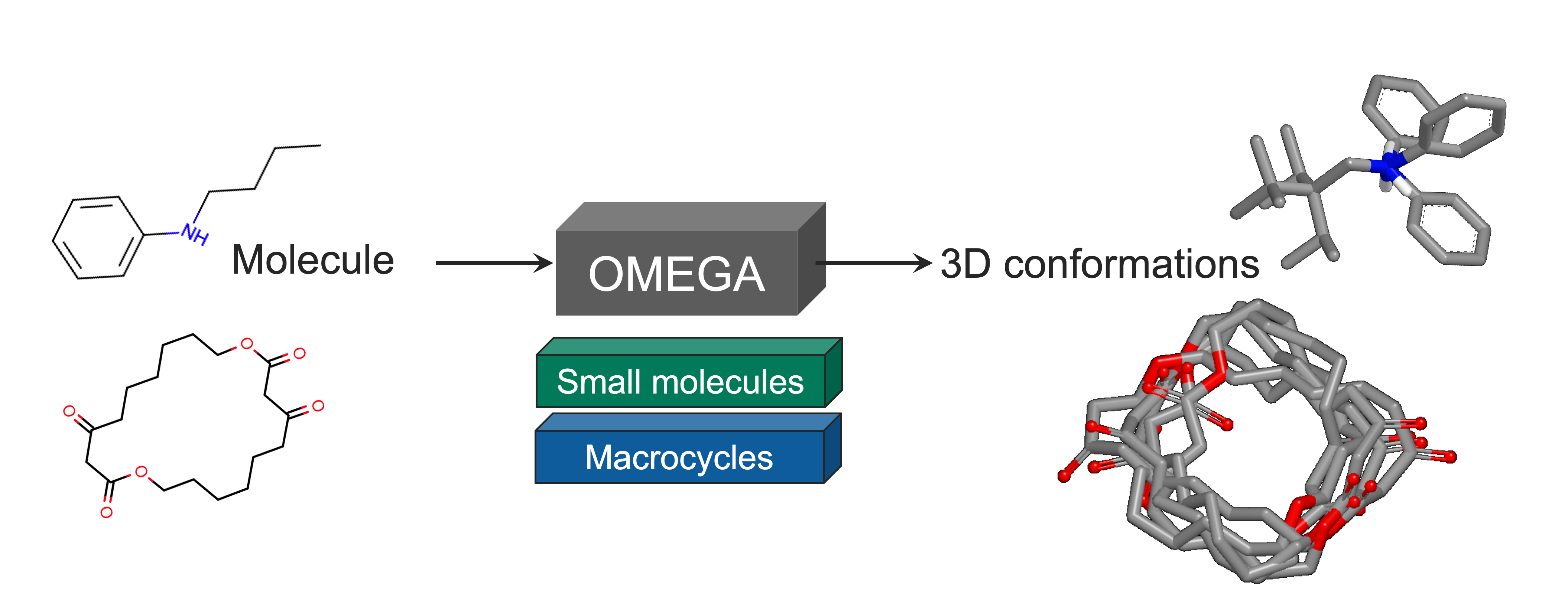
Figure 2. Overview of the two conformer generation approaches in OMEGA: distance geometry for macrocycles and torsion driving for linear molecules.
Torsion Driving (TD) in OMEGA
The torsion driving (TD) algorithm of OMEGA is composed of two main components; building the molecular scaffold (model) from non-rotor fragments and sampling the torsional degrees of freedom. Model generation may be bypassed by importing fragment structures from external sources ([Hawkins-2010]; [Hawkins-2012]).
OMEGA builds initial structures for the molecule by assembling fragment templates along sigma bonds. Input molecules’ graphs are fragmented at exocyclic sigma, and carbon to heteroatom acyclic (but not exocyclic) sigma bonds. Conformations for the fragments are either retrieved from pregenerated libraries built with MakeFraglib or constructed on-the-fly using the same approach that MakeFraglib uses. Molecule assembly is accomplished by simple vector alignment since all interfragment joints are along sigma bonds.
Once an initial structure is constructed or given as input, OMEGA generates additional ones enumerating ring conformations and invertible nitrogen atoms. Ring conformations are taken from the same fragment library used to build the initial model. OMEGA detaches all exocyclic substituents from a ring system, then aligns and attaches them relative to the new ring conformation. OMEGA attempts to generate every possible combination of ring conformations possible for a given structure.
The next step in model generation is to detect and enumerate invertible nitrogens. Nitrogens that have pyramidal geometry, no specified stereochemistry, no more than one hydrogen, are three valent, and have no more than three ring bonds are considered by OMEGA to be invertible. Invertible in this context simply means that at room temperature a pyramidal nitrogen is likely to be able to rapidly (on an NMR timescale) interconvert between two puckered forms. All multiconformer ring models are further expanded by enumerating all possible nitrogen puckers. The resulting model set is the starting point for conformer search by torsion driving.
OMEGA begins the torsion search process by examining the molecular graph and determining the bonds that may freely rotate. By default, OMEGA selects acyclic sigma bonds that have at least one non-hydrogen atom attached to each end of the bond. By default, hydrogen rotors (e.g., hydroxyl groups) are not altered during the torsion search; however, this can be enabled. The final ensemble selection is based on RMS distance of heavy atoms and sampled hydrogen atoms; unsampled hydrogen atoms do not affect this RMS distance. A list of possible dihedral angles are then assigned to each rotatable bond. The current mechanism for assignment is based on SMARTS matching, although alternate strategies for assigning angles based on experimental (i.e., X-ray) or theoretical (i.e., fragment optimization studies) are possible. The molecular graph is then subjected to pattern and geometric symmetry detection. Common patterns such as para-disubstituted benzene are used to reduce the number of symmetry equivalent dihedral angles that need to be searched. All torsions are altered by 120 and 180 degrees, and an RMS calculation is performed, taking into account symmetry-equivalent atoms in order to detect two- and three-fold symmetries. Once a set of nonredundant dihedral angles is assigned to each rotatable bond, OMEGA samples the torsion space through a systematic enumeration of combinations of these angles. Depending on the flexibility of the molecule, the maximum number of conformers to be generated, and the mode in which OMEGA is run, the algorithm to sample the torsion space is decided. By default, Thompson sampling, a Bayesian reinforcement learning algorithm, is used. The best conformers identified in the torsion search are rank-ordered by energy. A final ensemble is selected by sequentially testing the conformers using the RMS distance cutoff. To be accepted into the final ensemble, a conformer must have an RMS distance to every other member of the ensemble that exceeds the user-defined cutoff value. The final ensemble is populated up to the user-defined maximum ensemble size limit, or until the list of low energy conformers is exhausted.
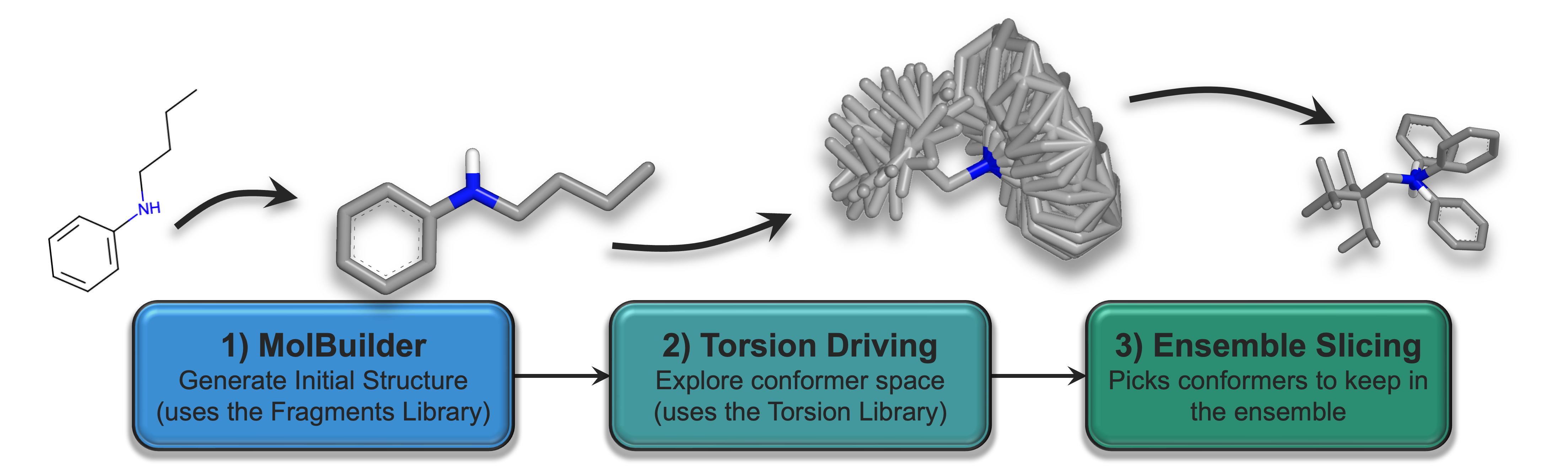
Figure 1. Illustration of steps in torsion driving OMEGA.
Thompson Sampling in OMEGA
The torsion library provides a set of likely dihedral angles for each rotatable bond. In Thompson sampling for torsion driving, we use these angles from the torsion rules as priors for a Bayesian process. Instead of enumerating every possible combination of angles and searching the combinatorially expanding space of conformers, conformers are instead generated based on these priors. For every angle for a given rotatable bond, a distribution of beliefs is maintained for modeling the likelihood of that angle to be part of a new low strain conformer. We sample these distributions to pick an angle for a given rotor. This process is repeated for every rotatable bond to pick a combination of angles that defines a conformer. After a conformer is generated, its energy is evaluated and the beliefs are updated based on the result. As we generate more conformers while continuously updating the beliefs, the sampling process is steered toward the low-strain structures of interest.
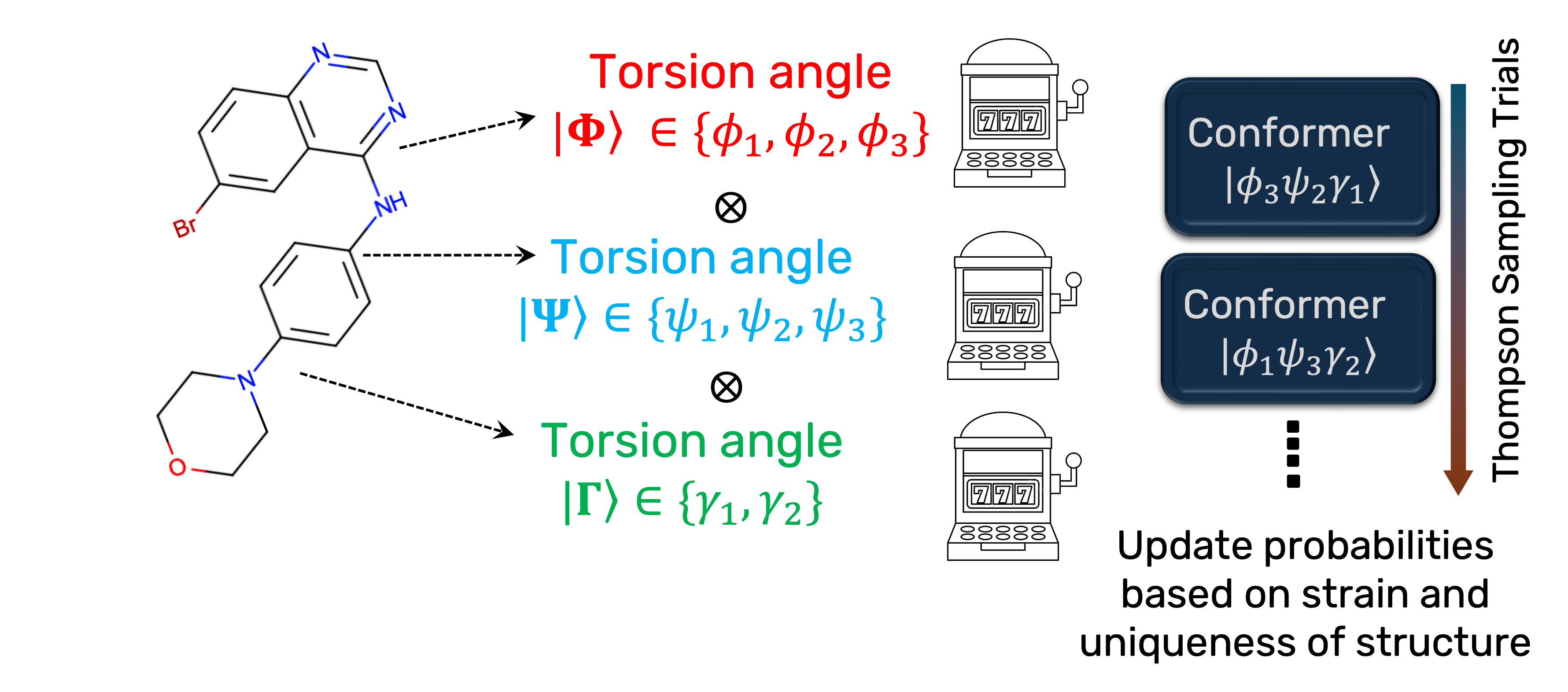
Figure 2. Illustration of Thompson sampling algorithm in torsion driving OMEGA.
Note
Conformers generated from OMEGA with default options do not maintain input relative stereochemistry, that is, cis/trans configurations for cyclohexane or other cyclic molecules.
OMEGA Sampling Modes
OMEGA provides a set of predefined sampling modes, each tuned for a specific downstream
application. Selecting the right mode ensures that the output ensemble is appropriately sized and
shaped for the intended use case: not too sparse to miss binding-relevant geometries, but
not so dense as to be computationally unaffordable in the downstream step.
All modes except macrocycle (see the Macrocycle Conformations section)
share the same underlying torsion driving (TD)
algorithm described in Torsion Driving in Omega, but they differ in the default values of key
parameters such as the maximum number of conformers, energy window, and RMS pruning threshold.
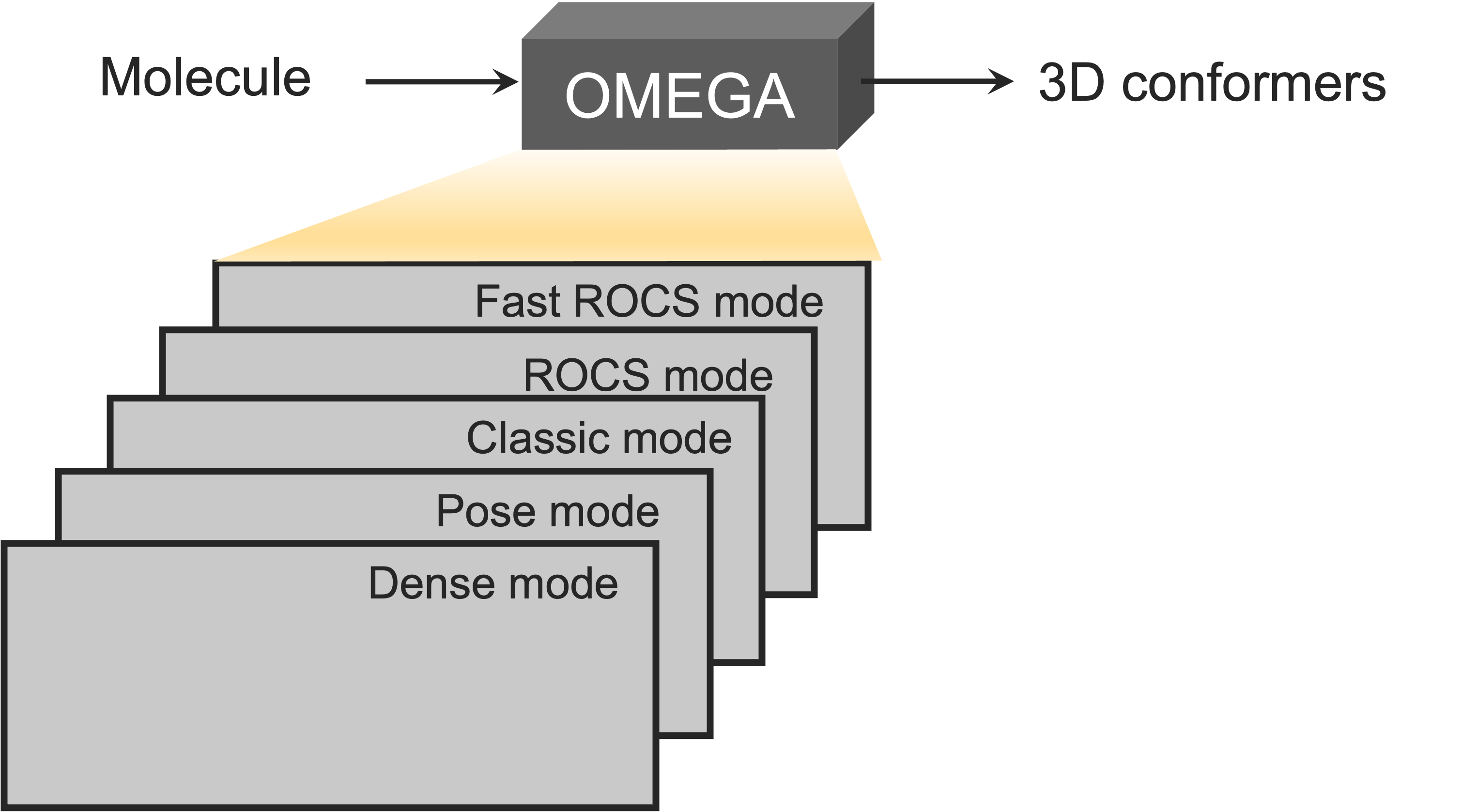
Figure 1. The torsion driving sampling modes in OMEGA.
The classic mode is the default mode. This allows a maximum of 200 conformations for a molecule.
These conformers represent a gas-phase ensemble. The fastrocs and rocs modes are tailored toward
effective use in shape-based virtual screening applications: FastROCS and ROCS, with a
maximum of 10 and 50 conformations, respectively. The pose mode is designed for docking
with OEDocking (FRED/HYBRID) and allows up to 800 conformations for molecules with eight or more rotors.
The dense mode is designed for free-energy or solvation calculations with Freeform and generates
large ensembles (up to 20,000 conformations) with a tight RMS pruning threshold and a wide energy window
to provide thorough coverage of accessible conformational space.
Each of these modes not only has its own set of default parameters for ensemble slicing that are optimized for the intended downstream application, but the Thompson sampling strategy is also tailored for each mode, based on the typical flexibility of the molecule and the maximum number of conformers generated in that mode.
Choosing a Mode
The table below summarizes the recommended mode for common downstream applications:
Mode |
Downstream Application |
Key Characteristic |
|---|---|---|
|
General purpose |
Gas-phase ensemble with balanced defaults |
|
FastROCS GPU screening |
Compact ensemble (up to 10 confs) |
|
ROCS shape screening |
Moderately sized, representative ensemble (up to 50 confs) |
|
OEDocking (FRED/HYBRID) |
Wide energy window for bioactive conformers, up to 800 confs for flexible molecules |
|
Freeform free energy |
Very dense ensemble with solvation scoring |
Macrocycle Conformations
Torsion driving conformational sampling methods such as described in the Torsion Driving (TD) in OMEGA section often perform poorly for macrocyclic molecules due to the problem of ring closure after the torsion driving step. Conformational sampling of macrocycles therefore requires a different approach; we address this issue with OMEGA using distance geometry (DG) [Hawkins-2020]. Other methods have been applied to this problem, such as distance geometry (DG) [Crippen-1988], molecular dynamics (MD/LLMOD) [Watts-2014], MD with perturbation along low energy eigenvectors [Labute-2010], and inverse kinematics [Coutsias-2016]. It is important to note that OMEGA DG also works well for very flexible linear molecules which have such a large conformational space that torsion driving may not be able to adequately sample it.
OMEGA’s method of conformational sampling of macrocycles is an adaptation of the distance geometry method of Spellmeyer et al. [Spellmeyer-1997]. In this method, a traditional embedding DG algorithm is replaced with a direct error function minimization of the random atomic coordinates, followed by force field refinement. Each initial Cartesian atomic coordinate x is assigned by choosing a random number r between -1 and 1, multiplied by a factor \(f\sqrt{N}\) which determines the box of maximum extent for a molecule with N atoms:
Alternatively, instead of randomly placing atoms in Cartesian space, the method allows for random placement of rigid fragments such as aromatic rings, nitro groups, and so on. After randomly placing molecules, atoms, or rigid fragments, an error function of the form:
is optimized. In the above equation, the first sum runs over all pairs of atoms in the molecule, where \(d_{ij}\) are the interatomic distances and \(c_{ij}\) are elements of the constraint matrix; they are obtained from the MMFF94 force field parameters. When atoms (i,j) are bonded or are the first and last atoms in a bond angle, the upper and lower bounds are the same and are taken as the corresponding equilibrium force field distances. When atoms (i,j) are the first and last atoms of a torsion angle, the lower bound corresponds to the cis configuration and the upper bound to the trans configuration of those atoms. Finally, when atoms (i,j) are separated by more than three bonds, the lower bound is taken as the sum of the vdW radii and the upper bound as the sum of bond lengths which separate the pair. The second summation in equation (2) is over the tetrahedral constraints which result from:
planarity
chirality
cis-trans isomerism
Optimization of the error function (2) leads to a rough conformation. No hydrogen atoms except those which are bonded to chiral atoms are included in the error function minimization. Each rough conformation is checked for chirality correctness before refinement. If the rough conformation passes the chirality checks, it is refined against a forcefield, MMFF94 ([Halgren-I-1996], [Halgren-II-1996], [Halgren-III-1996], [Halgren-IV-1996], [Halgren-V-1996]). Solvent forces can be included in the refinement step using a simple continuum solvation model (the Sheffield model [Grant-2007]). When the sequence of random placement followed by error function minimization and force field refinement is repeated for a large enough number of times for a given macrocycle, its conformational space is reasonably well covered.
Special measures are taken for zwitterionic molecules (containing both positively and negatively charged groups, such as \(CO_2^-\) and \(NH_3^+\)). In order to prevent possible Coulombic collapse in the absence of a stabilizing receptor, zwitterionic molecules are neutralized before performing the distance geometry calculation and the refined structures are recharged before writing them out. This approach meaningfully improves OMEGA’s ability to reproduce solid-state conformations of zwitterionic ligands.
This method of conformation sampling is completely general and can be used to generate conformations
for any molecule, whether or not it contains a large ring. However the macrocycle mode in OMEGA has
been specifically developed and parameterized to perform well on macrocycles, therefore its performance
on linear and small ring molecules is worse than with classic OMEGA.